Economics
Beginner
What is
Venture Capitalist (VC)?
An investor or firm that provides capital to startups and small businesses, usually in exchange for an allocation of the project's tokens at a significantly lower price.
An investor or firm that provides capital to startups and small businesses, usually in exchange for an allocation of the project's tokens at a significantly lower price.
Related Infographics
Related Articles
Frequently Asked Questions
Questions about Venture Capitalist (VC)
Common questions about this topic
How to escape financial repression with Ergo?
Ergo provides tools for financial sovereignty: self-custody with no third parties, censorship-resistant transactions via PoW, optional privacy with Sigma Protocols, and programmable money without permission. Unlike VC-backed chains, Ergo has no central authority that can freeze funds or comply with sanctions. Your keys, your coins, your freedom.
Solution
Philosophy
Why does Ergo's fair launch matter?
Ergo had no pre-mine, no ICO, no VC allocation. 100% of ERG enters circulation through mining. That removes a major insider-allocation overhang and makes governance less dependent on early investor exits. Long-term decentralization still depends on active miners, users, builders, and community participation.
Philosophy
Philosophy
Why does Ergo's lack of VC funding matter?
VC-funded chains have misaligned incentives: VCs need exits, so they push for hype over substance, centralized control, and token dumps. Ergo's fair launch means no insider allocations, no pressure to pump price, and no corporate governance. The community controls Ergo, not investors seeking returns.
Philosophy
Philosophy
What is eUTXO and how does it work?
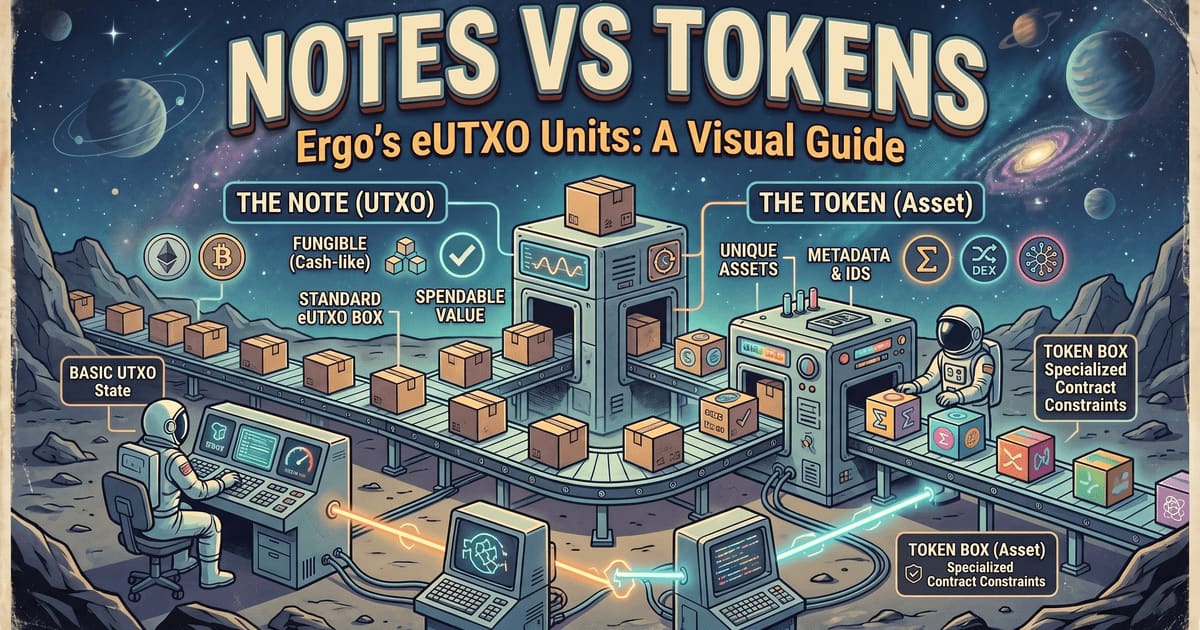
eUTXO (Extended Unspent Transaction Output) is Ergo's smart contract model that extends Bitcoin's UTXO with programmable logic. Each 'box' contains ERG, tokens, data registers, and a guarding script. Transactions consume boxes and create new ones, enabling deterministic execution, parallel processing, and no protocol-level reentrancy by construction.
Explainer
Technology