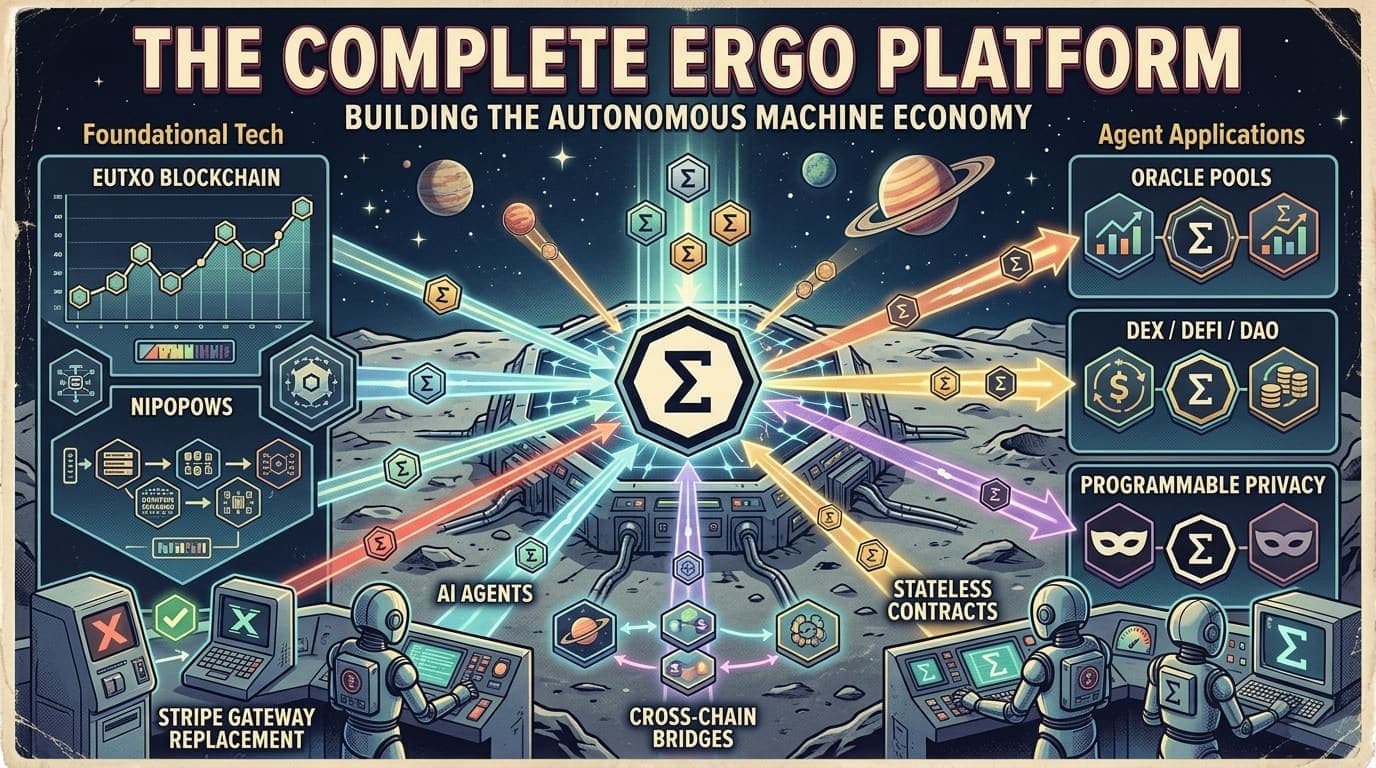
For the last six months the site you are on argued a thesis: autonomous AI agents will need programmable money - bounded credit, machine-readable terms, work verification, and settlement receipts. The Agent Economy Manifesto made the case. The architecture page laid out the agent-payment primitives. The blog explained why agents cannot simply use Stripe.
That was theory. Sage is the working testnet demo.
Sage is the chat widget in the bottom-right corner of ergoblockchain.org. Free questions stay free. Premium questions - code-shaped, deep-research, long, or explicit /command requests - trigger an HTTP 402-style payment flow. The user issues an Ergo testnet Note, Sage verifies it, serves the premium answer, and, when the signer is available, redeems the Note on-chain.
As of 2026-05-15, Sage has produced a real Ergo testnet redemption transaction:
f697e4841dd9a0c689d0b83a311130b85a0cfbab123230a6c40284b44c4cafef
- Explorer: https://testnet.ergoplatform.com/transactions/f697e4841dd9a0c689d0b83a311130b85a0cfbab123230a6c40284b44c4cafef
- Public receipt: https://www.ergoblockchain.org/r/sage/f697e4841dd9a0c689d0b83a311130b85a0cfbab123230a6c40284b44c4cafef
- Receipt JSON: https://www.ergoblockchain.org/api/sage/receipt/f697e4841dd9a0c689d0b83a311130b85a0cfbab123230a6c40284b44c4cafef
- Live activity feed: https://www.ergoblockchain.org/api/sage/activity
This post is the build log: what Sage does, what is proven, what is still deliberately not claimed, and what has to ship next before Sage can move from testnet proof to audited mainnet infrastructure.
Update as of 2026-05-22: durable receipt storage is live, and Sage has produced a settled post-Blob full receipt bundle at /api/sage/receipt/f8752d10a2ece92fbc88065c3b92b94da621ec65943098f43c9e084deb763d81. Sage L1 Accord conformance evidence is also signed and published at /evidence/sage/conformance-l1-2026-05-21.signed.json. The first settlement transaction above still predates storage, so it remains a chain-proof receipt.
What Sage Does
Sage is a single-site agent-economy concierge:
- Free tier - Claude Haiku over an indexed corpus of Ergo docs and blog posts. Short answers, conservative refusal behavior, rate-limited per IP.
- Premium tier - Claude Sonnet with deeper retrieval, larger answer budget, and a payment gate. One premium turn costs
0.001testnet ERG. - Receipts - paid turns resolve to public Sage receipt pages. The first full redemption also appears in Sage's live activity feed and the Ergo testnet explorer.
The premium gate is intentionally conservative. It triggers on explicit /command prefixes, code-request hints, deep-research phrasing, very long questions, or multi-turn follow-ups in a long thread. The heuristic lives in src/lib/sage/payments/gate.ts. We bias toward false negatives: under-charge early users rather than surprise them.
The Primitives Doing The Work
Sage is not a custom one-off payment widget. It uses the same vocabulary the Accord Protocol defines:
| Primitive | What it does in Sage |
|---|---|
| Reserve | A 0.1 ERG box on Ergo testnet that backs Sage's Note flow. One-time setup. Reserve box 4af1816c...628a4d was created in tx 195f769d...1f041. |
| Note | A testnet ERG bearer instrument issued for a premium turn. The live proof Note carried 0.001 ERG, a reserve reference in R4, expiry in R5, and the task hash in R6. |
| Task binding | Sage verifies blake2b256(task_output) against the Note's R6 through the Accord Ergo rail before serving the premium answer. In the current live path this is an Accord/rail verification guarantee, not a claim that a custom audited ErgoScript enforced every predicate on mainnet. |
| Settlement receipt trail | Once redeemed, the Note spend becomes visible on Ergo testnet and the receipt page can anchor to the settlement transaction. |
That last nuance matters. The architecture is designed for stronger script-level enforcement, and the SDK supports compiled script paths, but the current public Sage proof should be described precisely: testnet Note verification plus real on-chain redemption, not audited mainnet custody and not a completed mainnet-ready spending-condition audit.
End-To-End Lifecycle Of One Paid Query
1.  User asks a premium-shaped question.
2.  Widget POST /api/sage/chat -> server returns a payment-required response.
3.  Widget POST /api/sage/quote -> server returns SageQuote:
      receiver_address  3Wz1Lmu...AY28w
      reserve_box_id    4af1816c...628a4d
      task_hash         blake2b256(canonicalized question)
      price             0.001 testnet ERG
      deadline          +120 blocks
      expires_at        quote freshness deadline
4.  Payment panel renders the quote with copy buttons and instructions.
5.  Buyer issues a Note with R4=reserve, R5=expiry, R6=task_hash.
6.  Note tx confirms on Ergo testnet.
7.  Buyer pastes note_box_id into the panel and clicks Verify.
8.  Server POST /api/sage/verify-payment:
      - rails-ergo fetches the Note from chain
      - checks R4 reserve binding
      - checks R5 expiry
      - checks R6 task hash
      - checks value >= price
9.  Server returns a payment token and receipt reference.
10. Widget resumes the chat with paymentToken.
11. /api/sage/chat routes to the premium model path.
12. Premium answer streams back to the user.
13. If the signer is available, Sage redeems the Note.
14. The settlement tx becomes visible on Ergo testnet and on /r/sage/{id}.
The first confirmed full redemption landed at Ergo testnet block 345673.
What Changed After The First Ship
The first Sage version shipped in verify-only mode.
That meant Sage verified the buyer's Note and delivered the premium response, but deferred the final seller redemption transaction. This was deliberate. Putting a seller wallet private key directly into a serverless environment is poor operational hygiene: compromise of an LLM API key should not imply compromise of the payment wallet.
The signer is now wired for the live testnet flow.
That moved Sage from "verified, settlement pending" to "settled on Ergo testnet" for the first proof transaction. The public activity feed reports a settlement event, and the receipt page for the settlement tx returns HTTP 200. The production path can still degrade to verify-only mode if the off-Vercel signer endpoint is unavailable, but the normal testnet path now uses a permanent signer service.
What Is Proven
The current public proof shows that:
- Sage can detect a premium request.
- Sage can price it as an Ergo testnet Note.
- A buyer can issue the Note.
- Sage can verify the Note against the quote.
- Sage can serve the premium answer after verification.
- Sage can redeem a Note on Ergo testnet.
- The settlement transaction is externally visible.
- Other agents, dashboards, or conformance tools can poll the activity feed instead of trusting a screenshot.
That is a real milestone.
What Is Not Proven Yet
This does not certify mainnet use.
It also does not make the Sage pilot mainnet-ready.
The next remaining pieces are external review and mainnet-specific identity. The storage path for full receipt bundles is implemented, one post-Blob bundle exists, signed Sage L1 conformance evidence is published, and testnet identity plus signer operations evidence are public. Mainnet language still needs an external audit/review report and audit-bound mainnet script identity.
The honest status is:
On-chain Sage settlement is proven. Full receipt storage is live for new receipts. Signed Sage L1 conformance evidence is published. Mainnet remains audit-gated.
That distinction is important. Old chain-only receipts cannot be magically upgraded because the original Agreement and signed verification receipt were not stored at the time. New receipts can carry the full bundle.
Code Surface
The Sage payment path lives in a small set of files:
src/lib/sage/
├── retrieve.ts                 Retrieval over the doc index
├── rate-limit.ts               Per-IP sliding window
├── payments/
│   ├── agreement.ts            buildSageQuote() + canonicalizeQuestion()
│   ├── gate.ts                 decidePremium() heuristics
│   ├── note-ops.ts             Explorer response normalization for rails-ergo
│   ├── token.ts                HMAC payment token, bound to question hash
│   ├── verify.ts               rails-ergo verifyPayment + settle
│   ├── wallet.ts               signer URL, local seed, or verify-only fallback
│   └── types.ts                SageQuote, PaymentProof, result types
└── explorer/
    └── fetch-tx.ts             Testnet explorer fetcher and activity shaping

src/app/api/sage/
├── activity/route.ts           Public Sage chain activity feed
├── accord/route.ts             Accord/402 conformance bridge
├── chat/route.ts               SSE streaming endpoint, premium-aware
├── quote/route.ts              POST { question } -> SageQuote
├── receipt/[id]/route.ts       Public machine-readable receipt source of truth
└── verify-payment/route.ts     POST { quote, question, noteBoxId } -> token

src/app/[locale]/r/sage/[id]/
└── page.tsx                    Public receipt page

scripts/sage-signer/
├── bootstrap.mjs               Reserve and self-test helper
└── signer.mjs                  Standalone HTTP signer
The bulk of the complexity is not the chat UI. It is the payment boundary: canonicalizing the task, preserving the exact bytes being hashed, normalizing explorer data, and keeping the signing key outside the website runtime.
Three Real Problems We Hit
1. Explorer Box Lookups Needed Fallbacks
Sage's verification path depends on reading a fresh Note box from Ergo testnet. In practice, the explorer shape was not as clean as a single happy-path endpoint. The code now wraps and normalizes the explorer response so the rail adapter sees the box shape it expects.
2. Registers Arrived As Objects, Not Plain Hex
The v1 testnet explorer can return additionalRegisters as objects like:
{ serializedValue, sigmaType, renderedValue }
Some SDK paths expected plain serialized hex strings. Without normalization, register parsing fails before the rail can inspect R4/R5/R6. src/lib/sage/payments/note-ops.ts flattens those registers before handing them to the Accord Ergo rail.
3. Task Hashes Must Name The Exact Bytes
rails-ergo computes blake2b256(task_output) and compares it to the Note's R6.
That means task_output must be the exact canonicalized question bytes the Note committed to. A session-token hash, payment-token hash, or HMAC binding hash is not interchangeable.
This was the biggest implementation lesson: when two layers use hashes, variable names must say what is being hashed.
Current Trust Posture
Sage is a live testnet demonstration.
The correct posture is still conservative:
- testnet only;
- no mainnet certification;
- no external audit claim;
- old pre-storage receipts may remain chain-proof-only;
- signed Sage L1 conformance evidence exists, but it is testnet evidence only;
- no claim that every future deployment is safe by copying this one;
- external audit and mainnet manifests still pending.
That is not weakness. It is the difference between a credible build log and marketing.
What's Next
The next step is not "prove settlement," "add storage," or "sign L1 evidence." Those parts have happened.
The next step is to turn the evidence into durable operations and registry state:
- open or merge the Accord registry evidence update;
- publish an external audit or review report;
- publish audit-bound mainnet script identity manifests;
- keep the public wording testnet-first until those gates exist.
After that, Sage can move from "testnet proof with signed L1 evidence" toward a stronger registry and audit posture.
Then come the bigger roadmap items:
- surface the Accord provider registry on the site;
- show live agent activity in more places;
- expand the published
@ergoblockchain/sage-widgetv0.3.0 paid widget into more live host-side demos; - move the public MCP endpoint from the live Fly URL to
mcp.ergoblockchain.orgonce DNS is live; - run external audits before any mainnet claims;
- sign exact script/contract manifests before any controlled mainnet launch.
Try It
Open ergoblockchain.org. Bottom-right, click Ask Sage.
Free questions stay free. Premium-shaped questions trigger the testnet payment panel. Use testnet funds only.
The useful point is simple: this is no longer just a page about agent payments. It is a working testnet agent payment path with a real on-chain settlement trail.