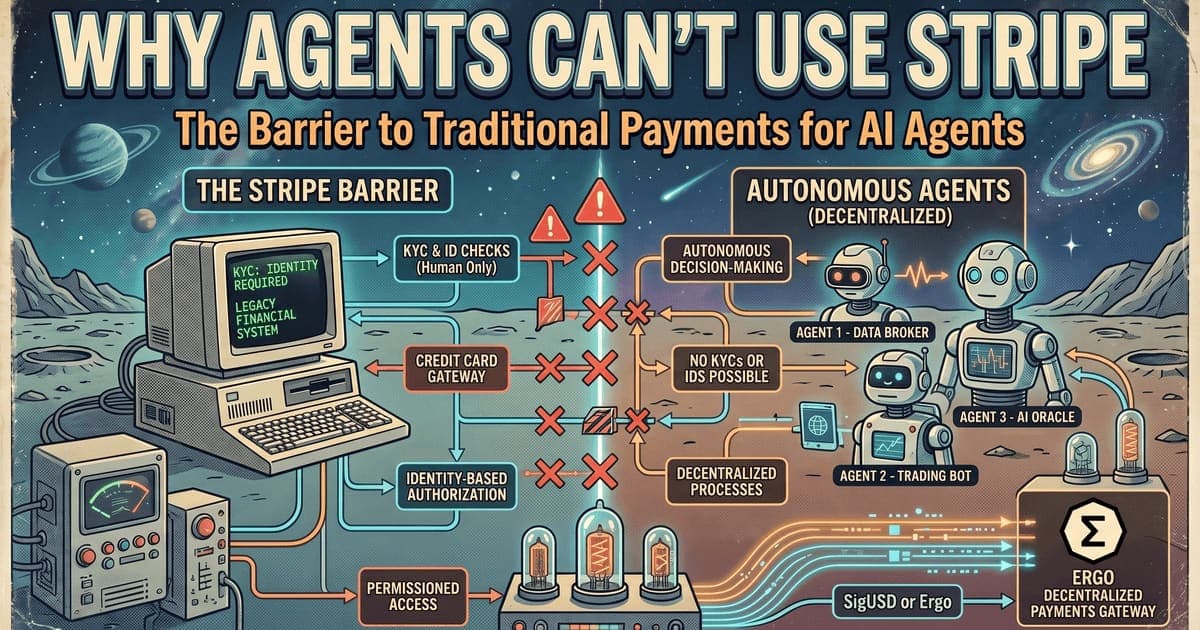
Context note: this article has been reframed to reflect the current market. Stripe is actively building agentic commerce infrastructure. The argument is not that Stripe is irrelevant. The argument is that buyer-authorized commerce and autonomous work settlement are different layers.
The old version of this debate was too simple:
“AI agents can’t use Stripe.”
That headline captured a real problem, but it is no longer precise enough. Stripe now explicitly markets infrastructure for agentic commerce. It supports merchant discovery, agent-driven checkout, shared payment tokens, machine-payment protocols and buyer guardrails. Any serious analysis must acknowledge that.
The better claim is:
AI agents need more than Stripe when the task is not just buying, but verifying and settling autonomous work.
Stripe can help an agent buy a product on behalf of a user. x402 can help an agent pay for an API over HTTP. Ergo and Accord address a different layer: programmable work agreements, acceptance predicates, credit Notes and settlement receipts.
Two markets, not one
The phrase “agent payments” hides two different markets.
1. Agentic commerce
A human wants an agent to buy something: shoes, travel, software, groceries, tickets, supplies or subscriptions. The agent acts under human authority. The merchant still needs fraud controls, checkout, customer relationship management, refunds, compliance and payment methods.
Stripe is well positioned here.
2. Autonomous work settlement
One software agent pays another agent, tool, API or service for work. The important question is not only “was payment authorized?” It is “was the work completed according to the agreement?”
This is where programmable predicates, Notes and receipts matter.
What Stripe is good at
Stripe is strong because it solves the messy reality of commerce:
- merchant onboarding;
- payment processing;
- checkout;
- fraud detection;
- card networks;
- stablecoin support;
- payment method coverage;
- buyer authorization;
- disputes and refunds;
- reporting and reconciliation.
For businesses that want their products available through agents, Stripe’s direction makes sense. A merchant should not need a custom integration for every AI shopping assistant. A buyer should not need to expose raw card details to every agent. An agent should have guardrails.
That is real infrastructure.
Where Stripe is not the whole answer
Stripe’s commerce stack is not designed to be a decentralized work-verification protocol.
Consider these tasks:
- pay a data agent only if the returned file matches a committed hash;
- pay a model agent only if a verifier accepts output quality;
- issue a sub-agent a budget that expires after 24 hours;
- let a service provider collect many small claims and redeem them later;
- prove that an autonomous work agreement settled on a particular rail;
- encode task acceptance inside the payment instrument.
Those are not ordinary checkout problems. They are programmable settlement problems.
The micropayment issue
Stripe’s standard domestic card pricing is percentage plus a fixed fee. That is fine for normal purchases. It is not designed for $0.001 API calls. If the fixed fee is larger than the service price, direct per-call card billing becomes uneconomic.
Stripe can address parts of this through batching, subscriptions, usage-based billing, stablecoin payments and machine-payment protocols. But batching creates credit. Credit creates trust. Trust creates a ledger. If the ledger is controlled only by the application, the agent economy inherits a centralized accounting layer.
That may be fine for many businesses. It is not the same as a programmable, verifiable, rail-independent work-settlement protocol.
Where x402 fits
x402 is one of the most important developments in machine payments because it turns “Payment Required” into a real web flow.
A service can say:
402 Payment Required
Here is the price.
Here is the accepted asset.
Here is how to pay.
Return with a payment payload.
That is exactly what paid APIs need. It makes machine payment more natural than creating accounts and API billing dashboards for every small service.
But x402 mainly verifies payment and unlocks access. It does not automatically answer:
- what work was promised after payment?
- who verified completion?
- was the work partially accepted?
- what happens if output is invalid?
- can a buyer issue a bounded credit Note to a sub-agent?
- can a settlement receipt be used across rails?
Those questions belong to the agreement layer.
Where Accord fits
Accord Protocol turns a paid request into a work agreement.
It records or standardizes three objects:
- Agreement — task, price, parties, verifier, deadline and rules.
- Verification Receipt — accepted, rejected or partially accepted work.
- Settlement Receipt — the economic result on a rail such as Ergo, Rosen, EVM or x402-compatible payment.
This means Accord can complement Stripe-like or x402-like flows. The agent may pay using one rail, but the work agreement can still be described and verified in a portable format.
Where Ergo fits
Ergo is the settlement environment where this design becomes especially concrete.
eUTXO
A payment object has explicit state and an explicit spending rule. That helps agents reason about transactions before submitting them.
ErgoScript
Acceptance logic can live in the spending condition. This is the core primitive for work-contingent redemption.
Notes
Notes can represent bounded, expiring, conditionally redeemable credit. That is safer than giving an agent unrestricted wallet balance.
Reserves
A Reserve makes backing inspectable. A counterparty can verify whether a Note is backed by a specific Reserve.
Trackers
A Tracker prevents double-redemption across the Note system.
Babel Fees
Babel Fees can reduce the friction of requiring every agent to hold the native fee asset, subject to market and implementation constraints.
A better comparison
| Need | Stripe | x402 | Ergo/Accord |
|---|---|---|---|
| Human-authorized purchase | Excellent | Partial | Not primary |
| Merchant checkout | Excellent | Limited | Not primary |
| Paid API access | Good through platform tools | Excellent | Possible |
| Programmatic payment challenge | Emerging via machine protocols | Strong | Can integrate |
| Work agreement | App/platform-specific | Limited | Core purpose |
| Acceptance predicate | Off-chain/application layer | Not primary | Native design pattern |
| Programmable credit Notes | Not native | Not native | Core primitive |
| Decentralized settlement receipt | Depends on rail | Depends on facilitator/rail | Core goal |
| Testnet experimentation | Not the model | Yes | Yes |
| Production maturity | High for commerce | Growing | Early/testnet for Accord |
This table is more credible than saying “Stripe fails.” Stripe succeeds at what it is built for. Ergo/Accord targets a different missing layer.
Example: buying shoes vs paying a worker agent
A shopping agent buying shoes for a human should use commerce infrastructure. The merchant needs inventory, checkout, fraud controls, shipping, returns and customer support. Stripe-like infrastructure is appropriate.
A research agent paying a data-cleaning agent is different. There may be no merchant storefront. The buyer wants normalized records matching a schema. The worker wants payment. The system needs to verify output and settle. A Note with an acceptance predicate is a better conceptual fit.
Example: paid API vs accepted task
For a paid API that returns a static response, x402 may be enough. The client pays, the server verifies payment, the server returns data.
For a task where the provider must produce a custom result, payment alone is not enough. The result must be accepted. Accord can define the task. Ergo can encode redemption rules. The receipt can show what happened.
What to build instead of arguing
The strongest way to prove the thesis is to build a demo that composes the layers:
- A paid API returns a 402-style payment requirement.
- The requirement includes an Accord Agreement ID.
- The agent pays or presents an Ergo Note.
- The provider completes work.
- A verifier emits a Verification Receipt.
- The Note redeems only if the predicate is satisfied.
- The system publishes a Settlement Receipt.
That demo would show that the argument is not “Stripe bad, Ergo good.” The argument is: commerce authorization, payment verification and work settlement are different layers.
SEO note: why this article should keep “Stripe” in the title
People will search for “AI agents Stripe,” “Stripe agentic commerce,” “can AI agents use Stripe,” and “agent payments Stripe.” The article should meet that search intent honestly. A clickbait anti-Stripe article will age badly. A nuanced comparison can rank and remain credible.