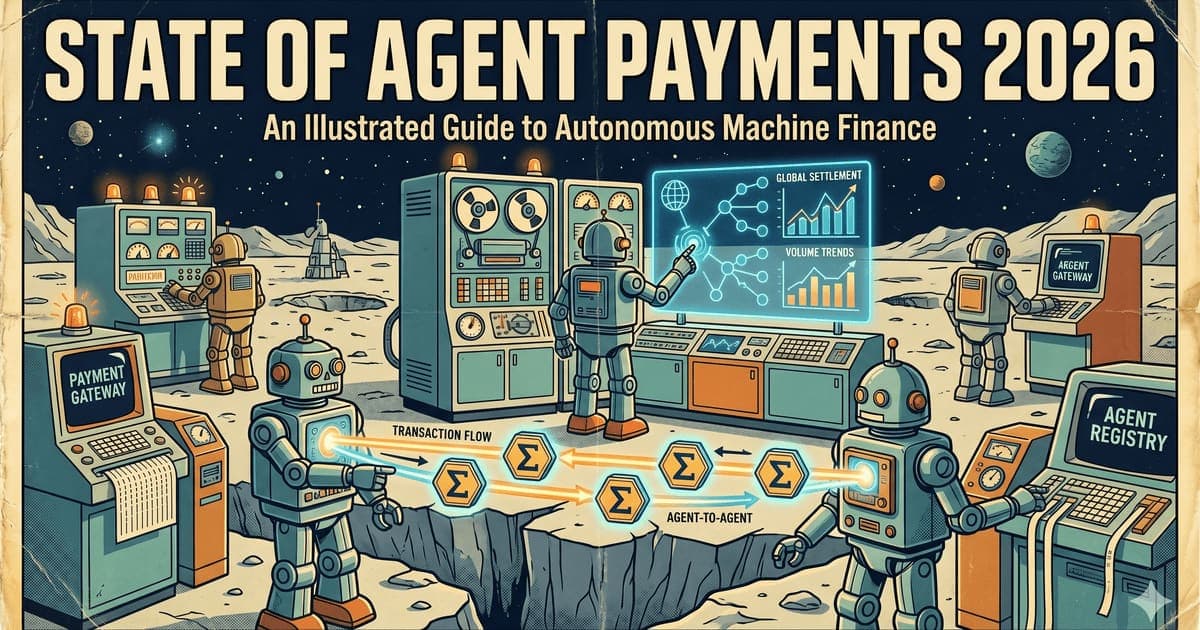
Status as of May 2026: this report separates live base-chain primitives from experimental agent-payment implementations. Ergo’s protocol is live. Accord Protocol, ChainCash/Basis reference contracts and most agent-payment demos are testnet-first until external audit manifests are published.
Update on 2026-05-22: Sage now gives Ergo/Accord a public testnet proof: a 402-style premium agent flow, one real Ergo testnet redemption transaction, durable full receipt storage for new paid turns, a permanent testnet signer service, a signed Sage L1 conformance artifact for a settled post-Blob full receipt bundle, testnet script identity and signer operations evidence, a published @ergoblockchain/sage-widget v0.3.0 paid-widget package, and a live MCP endpoint at mcp.ergoblockchain.org. The first settlement receipt remains chain-proof-only because it predates storage. The production caveat remains: external audit/review and audit-bound mainnet script identity are still required before mainnet claims.
AI agents can already write code, call APIs, plan tasks, retrieve data and coordinate with other agents. The missing piece is not intelligence. It is economic autonomy.
A human can sign up for a SaaS account, add a credit card, accept terms, open a dispute and reconcile invoices. A software agent cannot rely on that human payment loop if it is expected to operate at machine speed. The agent needs to discover a paid resource, understand price, commit to terms, pay or issue credit, prove that the task was completed, and settle without waiting for a person to click “approve.”
That is why 2026 is the first serious year for AI agent payments. The market is no longer hypothetical. x402 is reviving HTTP 402 for programmatic payments. Stripe is building agentic commerce infrastructure. Crypto rails are competing to provide low-cost settlement. Accord Protocol is framing the missing middle layer: verifiable work agreements.
The question is no longer “will agents pay?” The better question is:
Which layer of agent commerce are we talking about: authorization, payment, work verification, credit, settlement or dispute handling?
Different systems solve different layers. Confusing those layers is the main reason agent-payment debates are noisy.
Executive summary
x402 is the cleanest HTTP payment pattern
x402 is valuable because it maps paid access to a familiar web flow: request a resource, receive a 402 Payment Required response, submit a payment payload, and unlock the resource after verification. It is well suited for paid APIs, digital content, microservices and machine-readable billing.
Stripe is solving agentic commerce for merchants and buyers
Stripe’s Agentic Commerce Suite is not “old Stripe with AI branding.” It is an explicit push to connect businesses, agents and buyers, including machine-payment protocols, shared payment tokens, merchant controls and buyer guardrails. Any serious article about agent payments must acknowledge that Stripe is moving into this market.
Crypto rails solve settlement, but not necessarily work verification
Low fees and on-chain settlement are necessary. They are not sufficient. A payment rail can prove that value moved. It does not automatically prove that an agent delivered acceptable work.
Ergo/Accord’s strongest position is work verification plus programmable settlement
Ergo’s eUTXO model, ErgoScript, Notes, Reserves, Trackers and Babel Fees make it well suited for programmable payment instruments. Accord adds agreement, verification and settlement receipts above the rail. The clearest positioning is not “Ergo replaces everything,” but “Ergo/Accord solves the programmable work-settlement layer that ordinary payment rails do not address.”
The biggest risk is overclaiming readiness
The market is early. Accord and ChainCash/Basis are not production-audited. Any credible report must say so clearly.
Methodology
This report compares agent-payment systems across eight criteria:
- Micropayment viability — can the rail support tiny payments economically?
- Machine-native access — can software initiate payment without manual checkout?
- Identity flexibility — can ephemeral or delegated agents operate without becoming legal merchants?
- Deterministic cost — can an agent know the cost before committing?
- Programmable acceptance — can payment depend on task completion or a verifiable result?
- Programmable credit — can an orchestrator issue bounded spendable budget to sub-agents?
- Settlement proof — can the system produce durable payment or settlement receipts?
- Production maturity — is the implementation audited, standardized and widely deployed?
No system scores perfectly. The correct architecture will likely compose multiple layers.
The agent-payment stack
Agent commerce is not one thing. It is a stack.
| Layer | Question answered | Example systems |
|---|---|---|
| Discovery | Where can an agent buy this service? | Service directories, x402 Bazaar-style discovery, merchant catalogs |
| Authorization | Who allowed this payment? | Human wallet policy, SPTs, agent wallets, spending limits |
| Payment | Did value move? | x402, cards, stablecoins, Ergo, EVM, Solana, Lightning |
| Work agreement | What was promised? | Accord Agreement, service contract, task spec |
| Verification | Was the work accepted? | Accord Verification Receipt, acceptance predicate, oracle/verifier |
| Settlement | How was value finalized? | Ergo Notes, stablecoin transfer, card capture, invoice settlement |
| Audit trail | Can another system inspect the result? | On-chain tx, receipt, signed log, verifier statement |
Stripe is strong in merchant commerce, buyer authorization, fraud tooling and checkout. x402 is strong in HTTP-native payment flow. Ergo is strong in programmable on-chain settlement. Accord aims to connect work agreement, verification and settlement receipts across rails.
x402: the HTTP-native payment layer
x402 solves a very real problem: the web has a standard status code for “payment required,” but it was not historically usable as a practical payment protocol. x402 turns that idea into a developer flow.
A simplified x402 interaction looks like this:
- A client requests a paid resource.
- The server returns
402 Payment Requiredwith machine-readable payment instructions. - The client constructs and sends a payment payload.
- A facilitator verifies and settles the payment.
- The server returns the resource.
This is excellent for:
- API services paid per call;
- paywalled content;
- AI agents purchasing data or tools;
- usage-based microservices;
- simple programmatic payments without manual account setup.
The limitation is not that x402 is weak. It is that payment verification and work verification are different problems. If the server is selling a static API response, payment verification may be enough. If the task is “research this topic,” “produce an acceptable proof,” “train a model,” “complete a bounty” or “deliver a multi-step computation,” the system needs a way to record and verify the work agreement itself.
That is where Accord’s “x402 verifies payment; Accord verifies completion” framing is useful.
Stripe Agentic Commerce: the merchant-commerce layer
Stripe is approaching the agent economy from the business and buyer side. It wants merchants to expose products to agent surfaces while preserving catalog control, checkout, fraud prevention, payment compliance and customer relationships.
That is a real market. Agents will buy travel, clothing, software subscriptions, groceries and business services on behalf of humans. Those flows need guardrails, receipts, refunds, fraud controls, merchant-of-record logic and payment methods familiar to consumers.
Stripe’s strength is not programmable on-chain work settlement. Its strength is commerce infrastructure: onboarding merchants, processing payments, managing risk, supporting payment methods and connecting buyers to businesses.
A fair comparison therefore should not say “Stripe fails agents” in the absolute. The more accurate statement is:
Stripe is strong for buyer-authorized agentic commerce. It is not, by itself, a trust-minimized protocol for autonomous work verification, programmable bearer Notes or decentralized credit settlement.
That distinction makes the argument stronger, not weaker.
Ethereum and EVM L2s
Ethereum and EVM L2s have broad developer awareness, large stablecoin liquidity, account abstraction, wallets, smart contracts and many payment experiments. For many teams, EVM is the default choice because the ecosystem is large.
Strengths:
- huge developer base;
- stablecoin liquidity;
- smart-contract programmability;
- account abstraction and paymaster patterns;
- many infrastructure providers.
Weaknesses for autonomous agents:
- gas and fee markets can be variable;
- native gas-token bootstrapping remains a deployment consideration;
- work verification usually lives in application-specific contracts;
- escrow, upgradeability and oracle design can introduce complexity;
- MEV-like behavior can affect time-sensitive flows.
EVM systems can implement agent-payment applications. The question is whether the implementation remains simple, deterministic and verifiable under real multi-agent workloads.
Solana
Solana’s strongest advantage is fast, low-cost settlement and developer attention. For simple microtransactions, it is attractive. It also has growing wallet and stablecoin infrastructure.
Strengths:
- low fees;
- fast confirmation;
- consumer and AI developer mindshare;
- growing stablecoin rails.
Weaknesses for this specific use case:
- programmable work acceptance is application-level;
- credit instruments like Ergo Notes are not native to the same design;
- agent-payment protocols need additional conventions;
- operational history and architecture differ from PoW/eUTXO assumptions.
Solana may be a good payment rail for some agent tasks. It does not remove the need for agreement and verification logic.
Lightning
Lightning solves cheap Bitcoin-denominated payments. It remains an important design reference for micropayments.
Strengths:
- very low payment cost;
- Bitcoin ecosystem;
- real micropayment history.
Weaknesses for autonomous agents:
- channel management;
- online requirements;
- liquidity routing;
- limited arbitrary task predicates;
- less natural fit for programmable credit Notes and multi-agent budgets.
Lightning is strong for streaming value. It is not a complete agent work-agreement stack.
Ergo and Accord
Ergo’s advantage is not market size. It is primitive fit.
Ergo has eUTXO, which makes state transitions explicit. It has ErgoScript, which lets conditions live inside spending rules. It has native tokens. It has Babel Fees, which can reduce native-token bootstrapping friction. It has Sigma Protocols for privacy patterns. It has PoW settlement without validator governance pause mechanics. Most importantly for agent payments, the Ergo rail can model Notes, Reserves, Trackers and acceptance predicates as composable UTxO structures.
Accord then adds a protocol vocabulary:
- Agreement — what work was requested?
- Verification Receipt — was the work accepted?
- Settlement Receipt — how did the economic part settle?
The strongest Ergo/Accord claim should be precise:
Ergo is one of the few settlement layers with the combination of eUTXO, programmable acceptance predicates, native-token flexibility, Babel Fees and PoW settlement needed for trust-minimized agent work payments.
Avoid “only” unless the site publishes a maintained comparison matrix and defines the criteria narrowly.
Comparison table
| System | Best at | Weakest at | Agent-payment role |
|---|---|---|---|
| Stripe Agentic Commerce | Merchant commerce, buyer guardrails, fraud, checkout | Trust-minimized work predicates and decentralized credit Notes | Human-authorized agent commerce |
| x402 | HTTP payment challenge and API monetization | Complex work verification and programmable credit | Paid API/content access |
| Ethereum/L2s | Ecosystem, stablecoins, smart contracts | Deterministic simplicity and native work-credit primitives | General programmable settlement |
| Solana | Low-cost fast payments | Native work-agreement semantics | Simple machine payments |
| Lightning | Low-cost Bitcoin micropayments | Arbitrary predicates, credit budgets, async workflows | Streaming value and simple micropayments |
| Ergo/Accord | Work verification, Notes, programmable settlement | Adoption, liquidity, audit maturity | Agent work agreements and settlement |
What builders should do in 2026
If you are building a paid API, start with a 402-style flow. It is familiar, simple and easy to test.
If you are building agent-to-agent work, add an agreement layer. Define the task, price, verifier, acceptance rule and settlement rail before money moves.
If you need programmable budget for sub-agents, experiment with Notes on testnet. A Note can represent bounded, expiring, conditionally redeemable spending power.
If you are handling real funds, wait for audits or keep custody outside the experimental contract path.
If you are writing content about this market, stop framing it as one winner replacing all rails. The future is layered.
Predictions for 2027
- HTTP 402-style payment flows will become common for paid APIs.
- Agent wallets will add policy controls before they add full autonomy.
- Work verification will become the differentiating layer after payment becomes easy.
- Most “agent payment” demos will be payments-only and will struggle with refunds and failed work.
- Protocols that emit durable receipts will be easier to integrate into accounting, audit and compliance systems.
- Trust-minimized Notes and programmable credit will move from niche demos toward developer pilots when public proofs like Sage combine signed conformance evidence, registry evidence, permanent signer operations and audits.
- The winning architecture will compose human authorization, machine payment, work verification and settlement instead of treating them as one layer.